Dubai · Gulf Edu
You've no doubt noticed that since the war with Iran broke out, gas prices have spiked: up more than 50% since January. But there's another, less well known, natural resource also impacted by the conflict: helium. The world — and the war — don't function without it.
No helium? No new cellphones, laptops, cars, MRI machines, missiles: all require this finite and irreplaceable resource. The closing of the Strait of Hormuz in February trapped one-third of the global helium supply.
Then just weeks later: Iranian strikes on Qatar's major gas facility further rattled the supply chain. With the extent of the damage unknown, American industry is left desperate for answers as the helium crisis remains up in the air. Last march as a new war raged, Iranian missiles and drones hit military targets throughout the Middle East: oil tankers stuck in the Persian Gulf, and energy infrastructure.
All of it meant to destabilize the global economy. One of those high value targets attacked: Ras Laffan in Qatar - the world's largest facility for natural gas – and its byproduct helium. 7,100 miles away at the University of Chicago, Joe Sachleben was watching closely from his lab. Jon Wertheim: When you heard the news that there was an attack on the facility in Qatar, where did your thoughts go?
Joe Sachleben: Um I hope that people weren't hurt was first. And then second, it's like, this is gonna be a problem. I mean, I won't say the words - I was thinking.
But, you know, it's, like, crap. We're gonna have to deal with this and I might not be able to get helium. Helium is critical for those large cylinders: nuclear magnetic resonance machines.
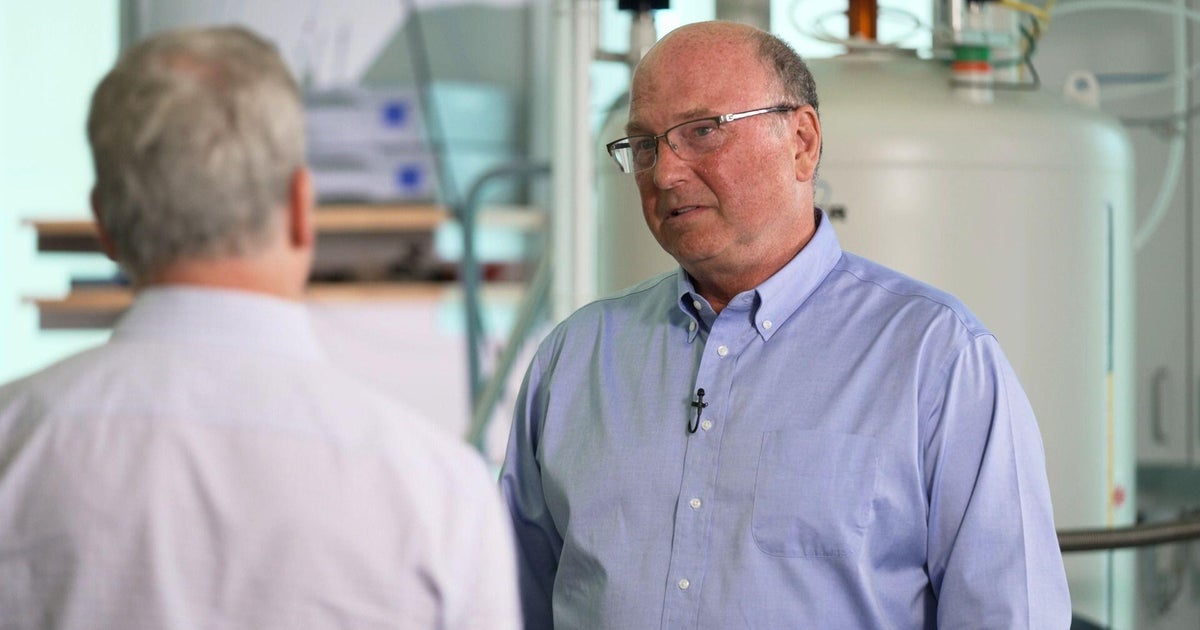
In Sachleben's lab, these machines are used by students, but also for higher stakes research to develop breast cancer drugs, immunotherapies, and treatments for Alzheimer's. Suddenly, it's all imperiled, collateral damage from the Iran war. Helium is the coldest liquid on earth.
So every couple months, Sachleben uses this long tube to pour 100 liters of helium on these magnets to stabilize them at 452 degrees below zero Fahrenheit. Jon Wertheim and Joe Sachleben 60 Minutes Joe Sachleben: Once it gets to a critical level, we have to put helium back in the magnet to keep it cold. Jon Wertheim: Right.
Joe Sachleben: If that doesn't happen, w-- we break the magnet. Jon Wertheim: You-- you've got problems if that doesn't-- Joe Sachleben: We have-- Jon Wertheim: --happen. Joe Sachleben: --huge problems.
Jon Wertheim: You're saying there-- there's no workaround here. There-- there's no other substance you can substitute in? Joe Sachleben: No.
Nothing else boils that low. Sachleben's lab contracts with one supplier to deliver the helium he needs each month. First U of Chicago's supplier placed Sachleben and his colleagues on what's called "allocation," essentially rationing.
Joe Sachleben: They basically have said, "Well, we'll give you 50% of what you used last year." That doesn't help us. And so what we have to do is decide which machine are we going to sacrifice and which one are we gonna try to keep. Jon Wertheim: That's where we are now?
Joe Sachleben: That's where we are now if we can't get the helium. Joe Sachleben: Fortunately, we found another supplier that is giving us helium on a fairly regular basis. But they can't guarantee it.
So we never know if they're gonna say, "Oh, this week, we don't have any." Then last month, Sachleben got a message saying that supplier was about to run out. It's not just university research labs. One fifth of the world's helium is consumed by the semiconductor industry alone to make every modern day electronic you might use, from your iPhone to your pacemaker.
Outside Minneapolis, we visited one of those chip makers, Polar Semiconductors. Surya Iyer: Alright so go ahead and put that on first. We suited up alongside Surya Iyer, Polar's president and COO, to go inside what's called the "Fab", the ultra sterilized area where they make the chips.
Our barriers to entry so to speak: two masks, two booties, and two pairs of gloves. Jon Wertheim: You wonderhow-- how many people going to the Mall of Americas have no idea what's going on a few hundred yards away. Surya Iyer: (LAUGH) That's absolutely true.
Inside, workers in round-the-clock shifts manufacture semiconductors for engine systems in cars, the U.S. military, and those ubiquitous data centers around the country. A helium gauge 60 Minutes Jon Wertheim: How does helium figure into this? Surya Iyer: I would say almost 40%, 50% of the machines in this factory would have helium in some way or the other in the machine.
Jon Wertheim: So it's not just one step of the process. Surya Iyer: No, no, no. Hundreds of steps in the process involve helium.
Such as this machine, where helium keeps the environment clean and stable to avoid defects on the wafers. Polar is able to hedge its helium reserves by relying on three suppliers. Still, the company has felt the effects of the shortage.
One of their suppliers has put them on allocation as well - that rationing program. Jon Wertheim: Just to be clear, if you did not have helium, what would happen in this facility? Surya Iyer: Well, that's a situation that I don't want to even imagine,because if we do not have helium, we'll have to shut down.
And– Jon Wertheim: Shut down– Surya Iyer: Everything gets shut down. And the helium crisis is hitting at a time when Polar Semiconductors plans on doubling production capacity to 140 million chips a month. Surya Iyer: Demand is not going down.
The AI data centers are growing lot of demand for semiconductors. Electrification is growing demand for semiconductors. And that means the demand for helium is gonna be growing for a long time.
Jon Wertheim: These data centers we keep hearing about, trillions of dollars popping up all over the U.S. Those don't happen if we don't have helium. Surya Iyer: Oh, yeah.
Without helium, none of these things happen. That's why local supply, supply in the United States is so important to us. Besides Qatar, the United States is the other major producer of helium for the world.
And most of that comes from a single facility in Wyoming. U.S. helium exports are up 70% since the war began and Ras Laffan was hit. This is mostly to accommodate countries manufacturing semiconductors.
But the U.S. can't offset the shortage indefinitely. And here's another issue: ramping up production of helium is not easy, even if you can find it. Four hours north of the Twin Cities we visited the site of a helium discovery, the Topaz Project.
Cliff Cain is president of the startup exploration company. Cliff Cain: So this is a wellhead. We drill down around 3,500 feet.
We hit the pocket of gas down there, and -- up comes the gas. It will come out this gauge here. And-- that's how it goes.
And once it goes, this finite resource is gone forever. Cliff Cain 60 Minutes For the record, Cain estimates about a dollar of helium is released every second that valve is open. His company has inserted seven wells around a 100-square-mile plot of land.
In most cases — including the Qatar facility — helium is a byproduct of the money-maker: natural gas extraction. In Minnesota, though, it's all helium, all the time. But finding helium is one thing.
Getting it to market, even in the best case scenario, will take years. Jon Wertheim: This is all encouraging. But this isn't gonna help us next month.
Cliff Cain: It's not gonna help us next month. It's not easy to find. It's not easy to build.
The logistics are hard, right? You've gotta keep-- something that's 452 degrees below zero cold. And it's perishable.
That's because helium starts to boil off as soon as it's in transit. It's that complicated supply chain that worries Cain, making helium, he says, particularly vulnerable to disruption. Cliff Cain: We've been trying to warn the markets about this for decades.
We're too concentrated with our supply in the world. When you look at it, you've got supply in Qatar. You have some supply in Algeria.
You have a little in Poland. You have a source in Russia. And we have a few here in the United States.
So all it takes is a few of those to fall and the whole supply chain comes unraveled. The longer the war with Iran continues, the tighter the global supply of helium gets. But how tight?
That's difficult to answer. If helium is hard to acquire, so is information about it. Jon Wertheim: Is opaque a fair word?
Rich Brooke: Oh, yes. Absolutely. It's a very tight-knit-- business with these six main players who are-- responsible for the majority of the sales.
Rich Brooke would know. He's a former executive at Air Liquide, one of the six major international helium suppliers, and is now an industry consultant. Jon Wertheim: How much have prices gone up this year?
Rich Brooke: The spot market prices have tripled. And-- and they can go even higher because-- Jon Wertheim: Tripled? Rich Brooke: Tripled.
Yes. Jon Wertheim: You-- you think it's-- Jon Wertheim: --expensive to fill your car up with gas. Rich Brooke: (LAUGH) That's right.
Jon Wertheim: The U.S. produces helium as well. Are there countries that had been relying on Qatar that are now coming to the U.S. for their supply? Rich Brooke: Yes.
Absolutely. Especially the countries that were-- heavily-- requiring helium for their semiconductor industries, there's only been traditionally two qualified sources. Qatar and Exxon, which is here in the U.S.
When Qatar went down, those companies, which are predominantly based in places like Korea and Taiwan and Singapore, immediately started looking-- towards the U.S. for supplies. Rich Brooke 60 Minutes Jon Wertheim: How long can the U.S. accommodate this demand from other countries? Rich Brooke: Well, it depends on how long the shortage lasts.
And also it depends on-- on how much product we can continue to recover out of the-- out of the caverns. He's referring to helium storage caverns — two in the U.S., one in Germany — illustrated in this diagram in blue. They are underground, made of salt, and naturally impermeable, which makes them ideal for holding excess helium when the market is long.
Jon Wertheim: Do we have any idea how much helium is in these caverns? Rich Brooke: So that's a closely held secret by the-- owners of the cavern. The market at one point last year was long.
So they were actually taking helium and pumping it into those caverns. Of course, now they've reversed the direction. Jon Wertheim: Three months from now, what does supply look like?
Rich Brooke: Well, if you can tell me what's gonna happen in the Strait of Hormuz between now and three months from now, I can tell you exactly what'll be happening in the helium business. Unfortunately, you can't and so I can't. In the aftermath of the Iranian strikes on Ras Laffan in March, the Qataris said it would take at least three years to get the facility back in full operation.
We wanted to know about the extent of the damage of the helium infrastructure specifically, but our requests for comment went unanswered. With so much at stake — and so much swirling uncertainty about the state of this vital element — we enlisted Joe Bermudez to assess how bad it could get. A senior imagery analyst at the Center for Strategic and International Studies, Bermudez looked for clues using what little information we do have.
It comes from a satellite... Joe Bermudez: It'd be nice if the Qatari government-- shared a little more... We provided Bermudez two images of an area of Ras Laffan that facilitates helium production - one before the Iranian strikes in March; one four days after.
He showed us this area where he says that it looks like water or firefighting foam dried to make a black stain on the cement. Joe Bermudez: It looks like-- something necessitated the pipes in this area, the equipment in this area to be hosed down. Jon Wertheim: So you're not prepared to say what it was or the severity, but something happened?
Joe Bermudez: Yes. Absolutely. For all the unanswered questions about the extent of the damage at the Qatar facility, this we know: the helium supply chain issues are sufficiently serious that Cliff Cain has briefed policymakers in Washington.
Jon Wertheim: When you addressed the Pentagon about helium, specifically, what were you telling them? Cliff Cain: That we have a problem. We have a single, critical point of failure in the system.
We have Qatar go down. Now that single, critical point of failure is coming closer to term. And I think that's what's got us concerned, it's 'cause that's all it does take.
Cain says it's especially concerning given that on account of the war with Iran, the U.S. is experiencing a munitions shortage — and yet the Pentagon has asked some defense contractors to quadruple their production capacities of certain weapons. Cliff Cain: You can't make modern warfare without helium. And that's just a fact.
You've heard about the missiles, the hypersonics. Without helium, you can't make the fiber optics. You can't produce the munitions.
You can't produce the electronics that goes on these things. And so if you don't have helium, your opportunity to make war becomes even more difficult. We are seven months into the war now, with no end in sight.
Since September, nearly two dozen ships have been hit while attempting to pass through the Strait of Hormuz. And no ships carrying helium are leaving Qatar. Produced by Lucy Hatcher.
Associate producer, Jessica Kegu. Broadcast associate, Mimi Lamarre. News associate, Eric Frank.
Edited by Michael Mongulla. In: Iran
Source: CBS News