Dubai · Gulf Edu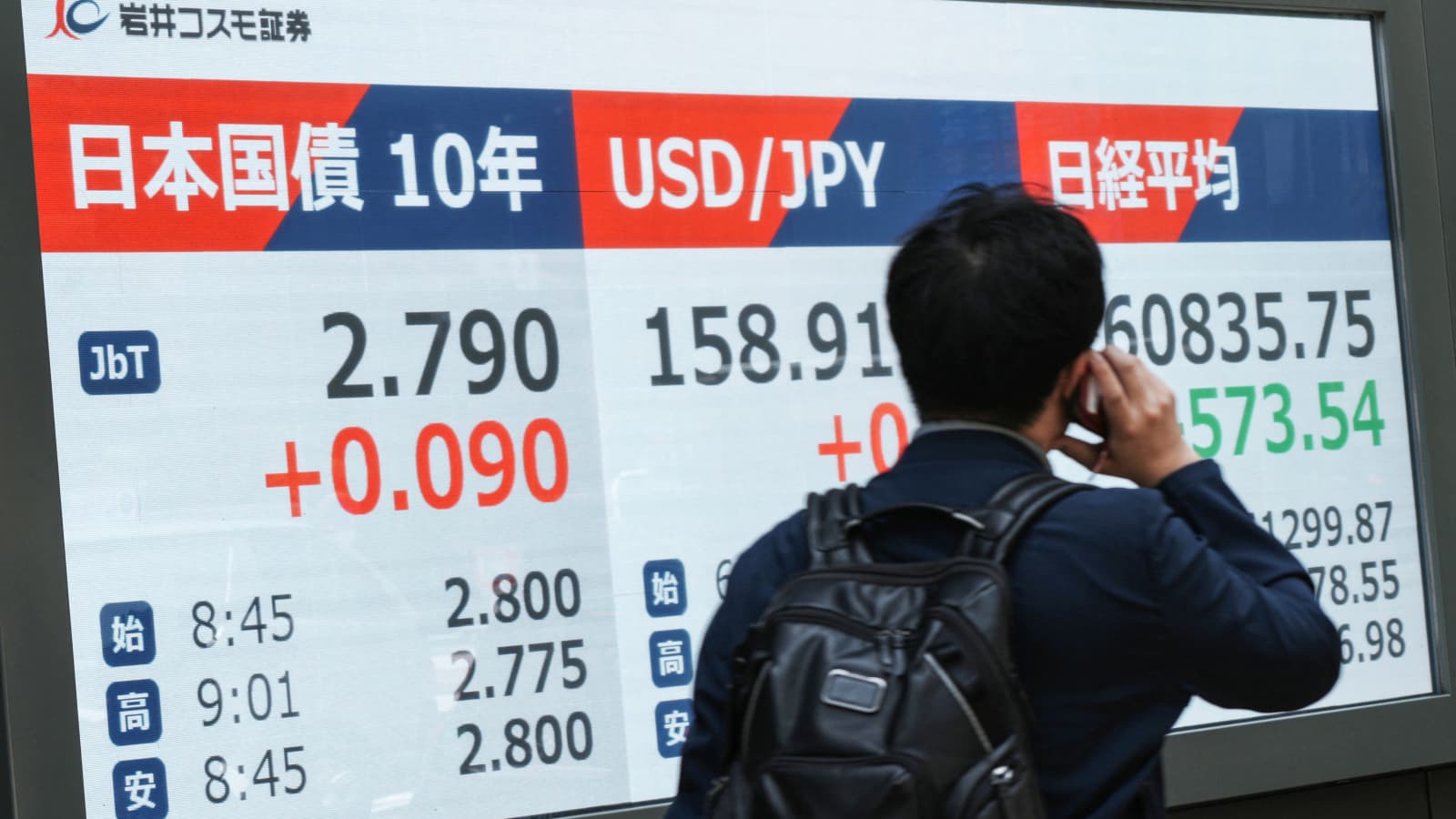
A man walks past an electronic quotation board displaying 10-year Japanese government bonds (L), an index of long-term interest rates on the Tokyo bond market, and the foreign exchange rate of the Japanese yen against the US dollar (C) along a street in Tokyo on May 18, 2026. Kazuhiro Nogi | Afp | Getty Images Japan's benchmark borrowing costs rose to their highest level in three decades on Tuesday, after U.S. Treasury Secretary Scott Bessent signaled that he expects action from Tokyo and the Bank of Japan to support the falling yen.
The Japanese 10-year yield rose 6 basis points on Tuesday to nudge above 3% for the first time since 1996. Global bonds were also under pressure, with U.S. Treasury yields broadly higher after a speech by Federal Reserve Chair Kevin Warsh was interpreted as hawkish by the market .
Bond yields move inversely to prices. The yen was last trading at 160.1 per dollar, breaching the 160 level some traders see as increasing the likelihood of further currency intervention for the third straight session. The U.S. and Japan conducted a rare joint intervention to support the yen in late July, but the currency has since surrendered much of its gains .
Stock Chart IconStock chart icon U.S. dollar/Japanese yen exchange rate. U.S. Treasury Secretary Scott Bessent told CNBC in a Monday interview: "I have information that the market doesn't have.
And it's my belief that the Japanese government and that the BOJ will do the things that will lead to a stronger yen." A U.S. official told broadcaster NHK that Bessent emphasized the need for Japan to communicate its path toward fiscal sustainability and further rate hikes in separate meetings with Japanese Finance Minister Satsuki Katayama and Bank of Japan Governor Kazuo Ueda. Katayama told reporters at the event that the U.S. and Japan had agreed to continue their coordinated effort to achieve "orderly" moves in the yen to ensure global market stability, and remained ready to act in response to "disorderly" market moves, according to Reuters. watch now A years-long slide in the yen is increasingly concerning to Tokyo because of the impact on consumer prices due to higher import costs. That worries Washington, according to analysts , because of the potential for Japan — the largest foreign holder of U.S. government debt — to finance an intervention with a major sale of Treasurys at a time when long-term borrowing costs are already under pressure .
Major moves in the Japanese market could also destabilize global markets, potentially weakening the dollar. Japan's higher borrowing costs on Tuesday reflect a rising chance of a Bank of Japan rate hike in September, and the market perhaps adjusting the terminal rate from 1.5% to 1.75% or higher, Takuji Okubo, managing director at Japan Macro Advisors, told CNBC. The terminal rate is the highest interest rate a central bank is expected to move policy to in the current cycle before it pauses or starts cutting.
Japan's benchmark rate is currently 1%. It also comes as global government borrowing costs hit multi-decade highs in economies across the world, with the resumption of military hostilities between the U.S. and Iran over the weekend reigniting inflationary fears. A 3% 10-year borrowing cost "is high in historical perspective, but it just means another step for Japan in leaving deflation in the past and joining the rest of the world where 2% inflation is an achievable normal," Okubo said. - CNBC's Lee Ying Shan contributed to this story.
Source: CNBC